Sea Turtle Season On The Ocean Ridge Coast: What's Happening Under Your Feet Right Now
July 16, 2026
July 16, 2026
If you have walked the sand between the Boynton Inlet and Oceanfront Park in the last few weeks, you have almost certainly stepped over a nest. Most residents of Ocean Ridge do, and never realize it. The wooden stakes and pink flagging tape look like erosion markers from a distance. They are not. Each one marks a clutch of loggerhead or green turtle eggs quietly incubating a few feet below the surface, waiting on a beach that happens to be one of the darker, quieter nesting stretches in the county.
This post is for the resident who wants to understand what is actually happening on their beach in mid-July, why this particular stretch matters to the animals using it, and what small habits change the outcome for the clutches sitting under your feet.
March 1st is the official start of the sea turtle nesting season in Florida, according to the Florida Fish and Wildlife Commission, and from March through the end of October three different species come ashore on the state's Atlantic and Gulf coast beaches to lay their eggs. That is the calendar most locals already carry in their heads. The story this year is the volume.
In a May 13 update, the FWC's Fish and Wildlife Research Institute reported that the 2026 season was off to a strong start, with 1,008 leatherback nests statewide (up about 4% from May 2025), three Kemp's ridley nests (up two from the same point last year), and 1,450 loggerhead nests, roughly 82% above the same-week count from the prior year.
Read that loggerhead number again. An 82% jump against a recent baseline is not a rounding-error season. By the time it filters down to the three-mile stretch of coastline that includes Ocean Ridge Hammock Park, it means denser staking, more nightly crawls, and a real chance of watching a hatch if you know when to look.
The species overlap through summer, but the peak windows differ. If you are trying to time an evening walk, this is the working calendar for the Atlantic coast:
| Species | Nesting window | Where Florida ranks |
|---|---|---|
| Leatherback | March through July | The only state in the continental U.S. where they regularly nest, almost exclusively on the east coast |
| Loggerhead | April through September, with 90% of U.S. loggerhead nesting occurring in Florida and most of it on the east coast | Global stronghold |
| Green | June through late September, with the highest concentration along the east coast | Second-largest Western Atlantic aggregation |
Mid-July is the crossover point. Leatherback nesting is winding down, loggerheads are still coming ashore most nights, and green turtles are ramping up. Meanwhile the earliest leatherback clutches, laid back in March, are hatching. If you see a shallow depression in the sand with a spray of small tracks radiating toward the water at dawn, that is what you are looking at.
There is a reason nesting concentrates on the Ocean Ridge shoreline rather than the more built-up beaches to the north and south. It is not sentiment. It is dune geometry and light.
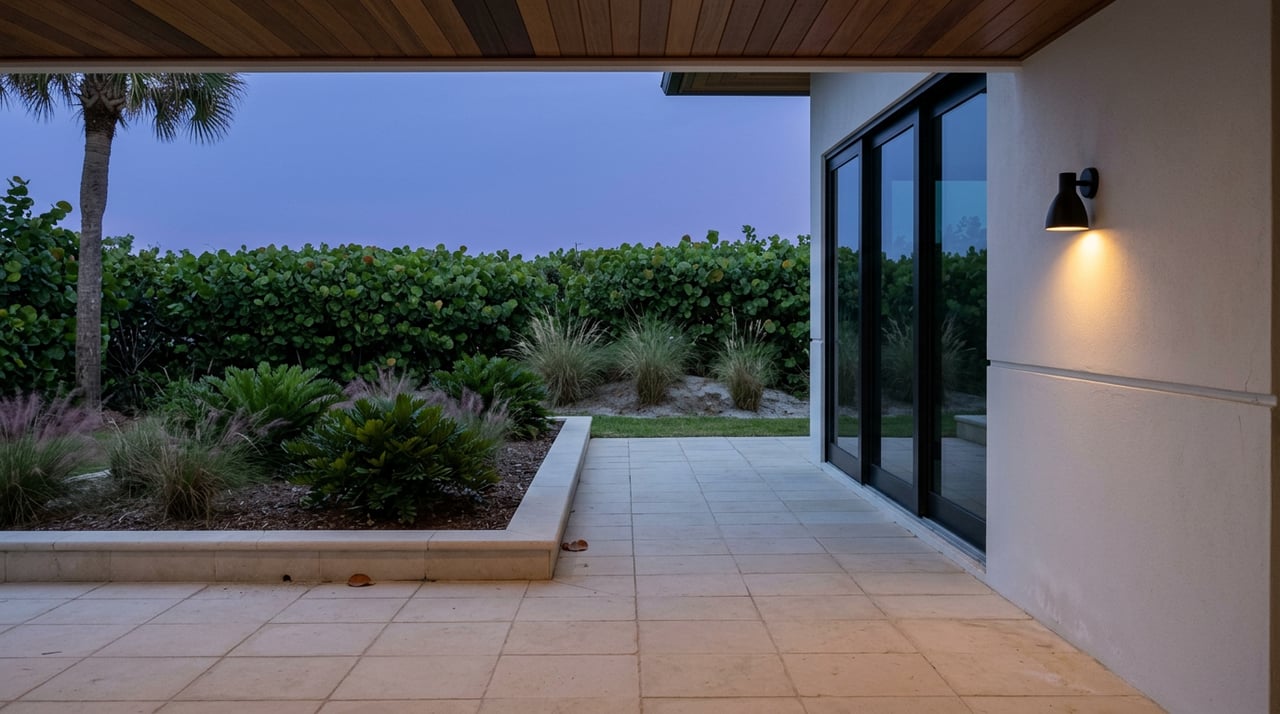
Ocean Ridge Hammock Park is a small, 8.54-acre beachfront park buffered from A1A by a thick coastal forest of mainly massive sea grape trees mixed with gumbo limbo, paradise trees, sabal palms and strangler figs, with a short path cutting through the hammock to the dune and down to the beach. That hammock does two things for turtles. It physically blocks headlight glare from A1A, and it shelters an intact natural dune line that most of the developed coast has lost. The naturalist writeup at Wild South Florida calls it the best stretch of natural beach dune in the vicinity, and that assessment is not marketing copy. It is a habitat description.
Sea grape leaves absorb light. Dune sunflower and sea oats hold the sand. A female loggerhead crawling up in the dark is looking for exactly this combination: a slope she can climb without hitting a seawall, sand loose enough to dig, and a horizon dark enough that her hatchlings will orient toward the moon on the water rather than a porch light behind her.
Which is why beach nourishment on this stretch gets scheduled around the turtles rather than the other way around. When Palm Beach County last renourished Hammock Park by piping sand from the Boynton Inlet, the dredging was timed so that it would not affect sea turtle nesting, and although the contractor planned to work 24/7 with on-beach lighting required for safety, the pipe simply moved sand from the interior waterways to the beach south of the inlet. That "timed so it will not affect nesting" clause is the one worth internalizing. Public works here bends to the biology.
The town's own code reflects the same instinct in surprising places. Ordinance 2026-01, adopted this year, requires all coconut trees in town to be trimmed annually by July 1 in preparation for hurricane season, noted as necessary to prevent personal injury and property damage during periods of high winds. That is a hurricane rule, not a turtle rule, but the July 1 deadline lines up neatly with peak nesting: the loud work happens before the beach fills with clutches.
The stakes and flagging you see did not appear on their own. They are the work of permit holders licensed by the FWC to monitor and mark nests on specific stretches of beach.
Two names to know if you live here. Sea Turtle Adventures is a 501(c)(3) nonprofit based in Boynton Beach, dedicated to marine conservation education along a three-mile stretch of South Florida coastline, and hosts beach cleanups, sea turtle nest excavations, nest adoptions, and educational programs, along with an annual Turtle Crawl fundraiser. That three-mile stretch is your stretch. The nest excavations, held a few days after a nest hatches, are one of the few legal opportunities to see hatchlings up close, and they are open to the public.
The FWC's public list of permit holders also names DB Ecological Services in Palm Beach, along with regional partners such as Loggerhead Marinelife Center in Juno Beach and Gumbo Limbo Nature Center in Boca Raton, both of which run rehabilitation programs and can accept reports of injured or disoriented animals. The FWC's viewing page at myfwc.com lists current permitted turtle walks and hatchling releases if you want to attend a formal program rather than stumble on one.
Every summer, someone in a beachfront rental leaves a porch light on all night and a dozen hatchlings crawl west toward A1A instead of east toward the ocean. That is preventable, and the fixes are boring on purpose.
None of this is heroic. It is the difference between a clutch of 100 loggerheads reaching the water and a clutch of 100 loggerheads crawling into a parking lot.
Nesting and hatching both happen after dark. If you want to watch either without joining a formal walk, the honest answer is: sit on the sand well back from the tide line, no phone, no flashlight, let your eyes adjust for twenty minutes, and wait. On a good July night on this stretch, something usually happens within an hour. If you would rather do it under supervision, the annual Turtle Crawl and the post-hatch nest excavations run by Sea Turtle Adventures are the closest permitted events to Ocean Ridge and the easiest way to see a hatchling in your hand before it goes into the water.
For everyone else, the turtles have been coming ashore here for longer than the road has been paved. The best thing a resident can do is turn off the lights and get out of the way.
If you are thinking about a move within Ocean Ridge or along the coastal corridor, or you already own here and want to talk through what a lighting-compliant renovation looks like on a beachfront lot, Grettie Sutton is available for a private consultation. Schedule a free consultation to start the conversation.
Stay up to date on the latest real estate trends.
Whether you're buying, selling, or just exploring your options, I’m here to guide you with expert insights and a personalized approach. Let’s start the conversation—reach out today!